
I enrolled at IIT Kanpur, a well-known engineering college in Northern India, for my Bachelor of Technology program. Like many others, I believed this accomplishment had secured my future, setting me on a clear path to success and fulfilment. But during my first year, a reunion of the 25-year alumni batch altered that belief. As I listened to these accomplished individuals share their stories, I was disheartened and disillusioned by the deep sense of dissatisfaction in their voices. It made me question what truly constitutes a good life—not in a relative, fleeting sense, but in absolute, enduring terms.
I became determined to uncover the answer to this elusive “good life,” willing to go to any lengths to find it, even though I had no clear idea of what it might be. This question became my life’s mission: What makes a good life? Even if the answer didn’t exist, I needed to know that for certain. So, in 1999, I made the bold decision to drop out of college and embark on this journey of discovery.
For the next four years, I immersed myself in an extensive array of subjects, diving into books that ranged from philosophy to quantum physics, mathematics, and eventually, spirituality. My pursuit of understanding was relentless, as I explored every possible avenue that might shed light on the concept of a good life. By the end of this period, I had gained a deep understanding of what others had discovered about this elusive idea, yet the answer still felt just out of reach.
Armed with this newfound theoretical understanding, I re-started my life and enrolled at Jawaharlal Nehru University (JNU), a renowned institution for Humanities in India, to pursue a master’s degree in International Relations. During my time there, I became deeply infatuated with a girl who did not reciprocate my feelings, and suddenly, my life felt as miserable as it could be. Despite all my intellectual pursuits, I found my daily existence no different from anyone else’s. Doubts began to creep in, and after two years, I decided to embark on another journey to find the answer. I dropped out once again and retreated to the Himalayas, where I spent four years. This time, however, I left the books behind and focused more on unlearning.
In the Himalayas, I met spiritual seekers who had reached elevated levels of consciousness. Yet, despite their spiritual achievements, they didn’t appear truly happy or fulfilled, and their lives seemed far from good.
Disappointed by my spiritual exploration, I returned after four years and decided to re-re-start my life. This time, I enrolled at IIM Ahmedabad, a Well known Institute of Management in Western India, for an MBA. It was 2009.
A decade later, in 2019, while working on Oltau.AI, an Artificial General Intelligence (AGI) system, I had a Eureka moment. I realized that the human brain operates as a Biological General Intelligence (BGI) system, similar to AGI. Just as AGI requires a Core Objective Function (CoF) and Independent Core Drives (ICD) to function effectively, so does BGI.
General Intelligence Systems can have one of three Core Objective Functions: to Survive, to Converse, or to Act. Systems with survival as their CoF evolve into species, such as Homo sapiens. Systems with the CoF to hold conversations develop into AI Generalists, like ChatGPT, which was developed by OpenAI. Systems with the CoF to perform specific tasks become AI Specialists, such as Alchemist, the AI AI-Developer created by Olbrain Labs.
To achieve their CoF, General Intelligence Systems develop ICDs. So, what are the ICDs of Homo Sapiens?
Reflecting on the spiritual seekers who, despite their elevated consciousness, were not happy, I pondered what happiness truly is. While reading the book “The Happy Brain: The Science of Where Happiness Comes From, and Why” by neuroscientist Dean Burnett, I discovered that happiness is directly and indirectly dependent on the quantity, quality, and proximity of our social connections. No wonder those spiritual seekers, living in isolation, felt unhappy.
Can “Happiness” be an ICD?
Yes, Humans are wired to connect.
However, I also met people who were socially well-connected and abundantly happy, yet still felt unsatisfied. They craved professional success and the dopamine rush that comes with it, missing the exhilaration of feeling “high.”
Could “Highness” also be an ICD?
Yes, humans are wired to compete and seek achievements. Like Sportsmanship.
Yet again, I encountered individuals who, despite their social connections and professional success, felt a void inside, yearning for inner peace. They longed for a sense of “Holiness.”
Could “Holiness” also be an ICD?
Yes, humans are wired to aspire to elevated levels of consciousness.
—
A journey that began in 1999 finally concluded in 2019. I consolidated my understanding from philosophy, spirituality, and AI technology into a comprehensive framework for a good life, which I named the Life 3H Framework.
—
Life 3H Framework—a revolutionary philosophy designed to redefine holistic living by harmonizing three ICDs: Happiness, Highness, and Holiness.
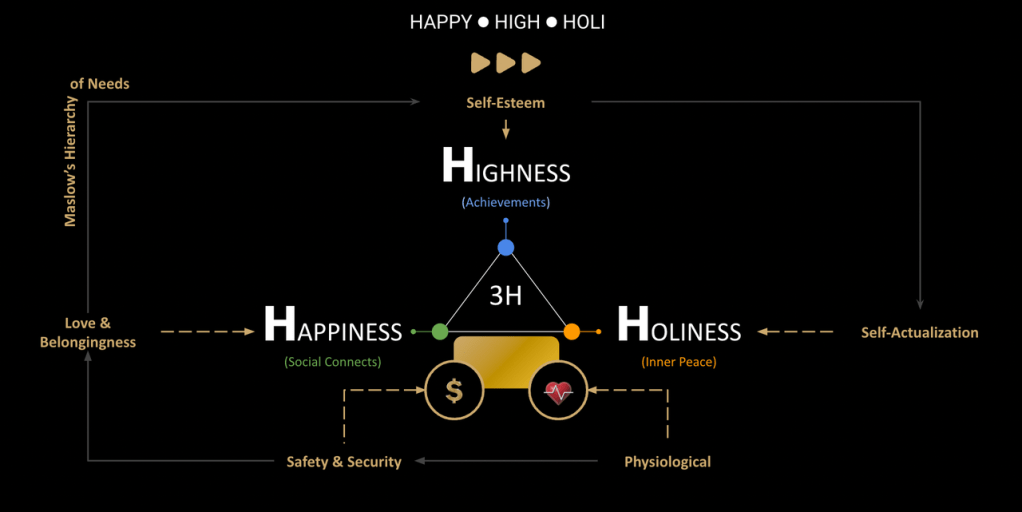
The Core Tenet: Balance and Fulfillment
At the heart of the Life 3H Framework is the belief that a fulfilling life hinges on a delicate balance among three fundamental drives:
- Happiness – Fulfillment derived from deep social connections.
- Highness – Success achieved through professional accomplishments.
- Holiness – Inner Peace cultivated through elevated spiritual consciousness.
These three dimensions are not just independent pursuits but are interwoven aspects of a life well-lived. The Life 3H Framework aims to integrate these dimensions seamlessly, creating a life that transcends conventional definitions of holistic living.
Understanding the F-Ratio: The Fulfillment Constant
Every individual is driven by unique core drives that shape their pursuit of happiness, highness, and holiness. These drives exist in specific ratios, known as the F-Ratio, which determines how much fulfillment one derives from each of the three dimensions.
Imagine plotting these drives on a graph: the distribution of each drive (Happiness, Highness, Holiness) across the global population would likely resemble a bell curve, ranging from 0% to 100%. The sum of these drives for any individual adds up to a constant—referred to as the Fulfillment Constant (F).
The Equation of Fulfillment
The Life 3H Framework is encapsulated in a simple yet profound equation:
F = Ha + Hi + Ho
Here, F represents the Fulfillment Constant, while Ha, Hi, and Ho correspond to the individual’s potential for happiness, highness, and holiness, respectively. The F-Value is unique to each person, and it is distributed across a bell curve, just like the individual values for Happiness, Highness, and Holiness.

Illustrating the F-Ratio
Consider two individuals with different F-Ratios:
- Person A has an F-Ratio of {20, 70, 10}. For this person, success is the most significant driver of fulfillment, while happiness plays a relatively minor role. This person can only achieve up to 20% fulfillment from happiness-related activities. If they have achieved 90% of their potential happiness, this translates to 18% fulfillment in happiness, leaving them with a small Happiness Deficit of 2% (20-18).
- Person B has an F-Ratio of {60, 15, 25}. Here, happiness is a much larger component of their fulfillment. If they have achieved 40% of their potential happiness (24% fulfillment), they still face a substantial Happiness Deficit of 36%, even though they are objectively happier than Person A (24% > 18%).
Pathways to Personal Fulfillment
The Life 3H Framework does more than quantify fulfillment; it offers insights into how individuals can enhance their life’s fulfillment by understanding their unique motivational profiles. By recognizing where one’s strengths and deficits lie, the framework illuminates the path to a more balanced and fulfilling life.
For example, someone with a low happiness ratio might focus on strengthening social connections and building more meaningful relationships to increase their overall fulfillment. Conversely, a person with a high success drive but a large deficit in this area may channel their energy into setting and achieving new professional goals.
Conclusion: A New Approach to Holistic Living
The Life 3H Framework is not just a theoretical model—it is a practical tool for anyone seeking a more balanced and fulfilling life. By understanding and applying the principles of Happiness, Highness, and Holiness, we can all take steps toward living a life that truly satisfies us on every level. In this way, the Life 3H Framework offers a revolutionary approach to holistic living, guiding us toward a life that is not only successful but deeply, authentically fulfilling.
The mission has garnered the support of numerous visionaries, and the movement is steadily gaining momentum day by day. As we collectively strive to reshape the narrative around fulfilment, we invite you to join us in this revolutionary journey.
 LIFE 3H by Alok Gotam